

Stewart, Robert Lee
United States Army
1964 - 1964
2022
Biography
Robert Lee Stewart was born on August 13, 1942 in Washington, DC. He graduated from Hattiesburg High School, Hattiesburg, Mississippi, in 1960 and received a bachelor of science degree in Mathematics from the University of Southern Mississippi in 1964,
Robert 'Bob' Stewart entered on active duty with the United States Army in May 1964 and was assigned as an air defense artillery director at the 32nd NORAD Region Headquarters (SAGE), Gunter Air Force Base, Alabama. In July 1966, after completing rotary wing training at Ft. Wolters, Texas, and Ft. Rucker, Alabama, he was designated an Army aviator.
Captain Stewart was assigned as a fire team leader in the armed helicopter platoon of "A" Company, 101st Aviation Battalion (redesignated 336th Assault Helicopter Company) in Vietnam. He flew 1,035 hours combat time from August 1966 to 1967. On 22 December 1966, Captain Stewart was the aircraft commander of an armed helicopter during the defense of a friendly outpost at Vi Thanh in the Republic of South Vietnam. Responding quickly to the radio call for help, Captain Stewart arrived over the outpost and immediately began flying firing passes at treetop level over the Viet Song battalion to slow its advance on the friendly perimeter. Ignoring the tremendous outburst of fire he drew on each pass, he dauntlessly attacked an enemy machine gun nest. Although his aircraft was hit on one of these passes and lost its hydraulic power, Captain Stewart calmly expended his ammunition on the insurgents and flew back to his staging area. After his helicopter was repaired and rearmed, he returned to the battle just as strike planes began hitting the Viet Song with devastating rocket attacks. Captain Stewart flew dangerously close to their strike zone in order to drive away insurgents attempting to creep into the perimeter of the outpost under cover of a heavy mortar barrage. His helicopter was again disabled by hostile fire, but he retained control of the aircraft and flew to friendly territory. His fearless and aggressive attacks were highly instrumental in enabling the friendly forces to completely rout the Viet Gong battalion , saving the outpost and its 230 refugees. For his bravery under fire on this date, Captain Robert Stewart was awarded the Distinguished Flying Cross, the nation's highest award for valor during aerial combat.
After Vietnam, he was an instructor pilot at the U.S. Army Primary Helicopter School -- serving 1 year in the pre- solo/primary-1 phase of instruction and about 6 months as commander of methods of instruction flight III, training rated aviators to become instructor pilots. He is a graduate of the U.S. Army Air Defense School's Air Defense Officers Advanced Course and Guided Missile Systems Officers Course. Captain Stewart received his master of science in Aerospace Engineering from the University of Texas at Arlington, in 1972. Major Stewart served in Seoul, Korea, from 1972 to 1973, with the 309th Aviation Battalion (Combat) as a battalion operations officer and battalion executive officer. He next attended the U.S. Naval Test Pilot School at Patuxent River, Maryland, completing the Rotary Wing Test Pilot Course in 1974, and was then assigned as an experimental test pilot to the U.S. Army Aviation Engineering Flight Activity at Edwards Air Force Base, California. His duties there included being chief of the integrated systems test division, as well as participating in engineering flight tests of UH-1 and AH-1 helicopters and U-21 and OV-1 fixed wing aircraft, serving as project officer and senior test pilot on the Hughes YAH-64 advanced attack helicopter during government competitive testing; and participation with Sikorsky Aircraft test pilots in developing an electronic automatic flight control system for the new Army transport helicopter -- the UH-60A Black Hawk. Additionally flew “quick and dirty” evaluations of the Bell YAH-63 and Boeing YUH 61 to evaluate fixes proposed by the airframe manufacturers to alleviate problems discovered in competitive tests.
He has military and civilian experience in some 40 types of airplanes and helicopters, including over 1200 hours of jet time, 1015 combat flight hours, and logged over 6,000 hours total flight time.
COL Bob Stewart became a NASA Astronaut in August 1979. His technical duties in the astronaut office have included testing and evaluation of the entry flight control systems for STS-1 (the first Space Shuttle orbital mission), ascent abort procedures development, and classified payload coordination. He also served as support crewman for STS-4, and Ascent/Orbit CAPCOM for STS-5. He served as a mission specialist on STS-41B in 1984. STS-41B Challenger (February 3-11, 1984) was launched from Kennedy Space Center, Florida, and returned to land there 8-days later. During the mission, COL Stewart participated in two extravehicular activities (EVA's) to conduct first flight evaluations of the Manned Maneuvering Units (MMU's). These EVA's represented man's first untethered operations from a spacecraft in flight. STS-51J in 1985, his second space flight, was launched from Kennedy Space Center, Florida, and after 98 hours of orbital operations returned to land at Edwards Air Force Base, California. It was the second Space Shuttle Department of Defense mission, and the maiden voyage of Atlantis, the final Orbiter in the Shuttle fleet. During the mission he was responsible for a number of on-orbit activities. COL Stewart has logged a total of 289 hours in space, including approximately 12 hours of EVA operations.
In 1986, while in training for his scheduled third flight to be known as 61-K, Col Stewart was selected by the Army for promotion to Brigadier General. Upon accepting this promotion, General Stewart was reassigned from NASA to be the Deputy Commanding General, US Army Strategic Defense Command, in Huntsville, Alabama. In this capacity General Stewart managed research efforts in developing ballistic missile defense technology. In 1989, he was reassigned as the Director of Plans, US Space Command, Colorado Springs, CO.
General Stewart retired from the Army in 1992 and currently makes his home in Huntsville, AL.
Oral History Interview
Watch Robert Stewart's oral history interview from our YouTube channel.
Media Gallery
Photos
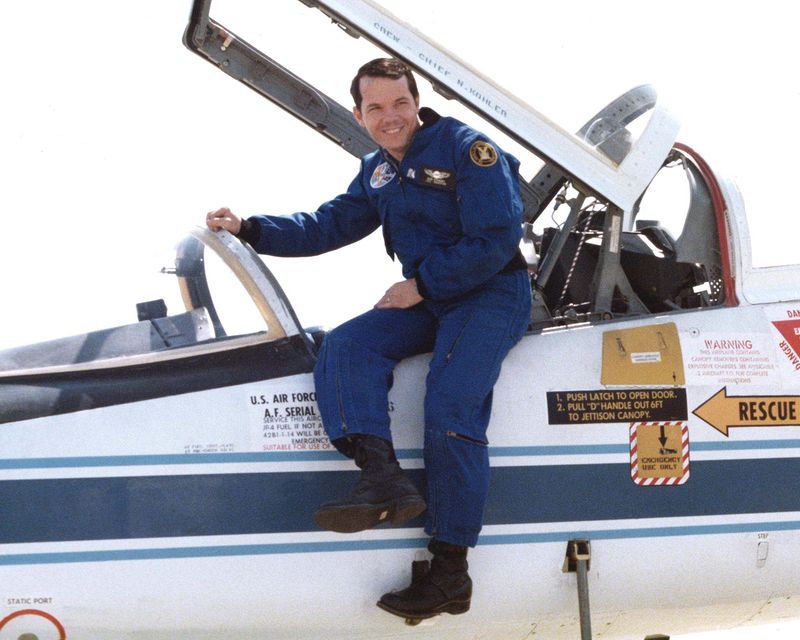
As the first Army astronaut, BG Stewart flew this T-38 jet for over 1200 hours in support of his duties in the Astronaut Office
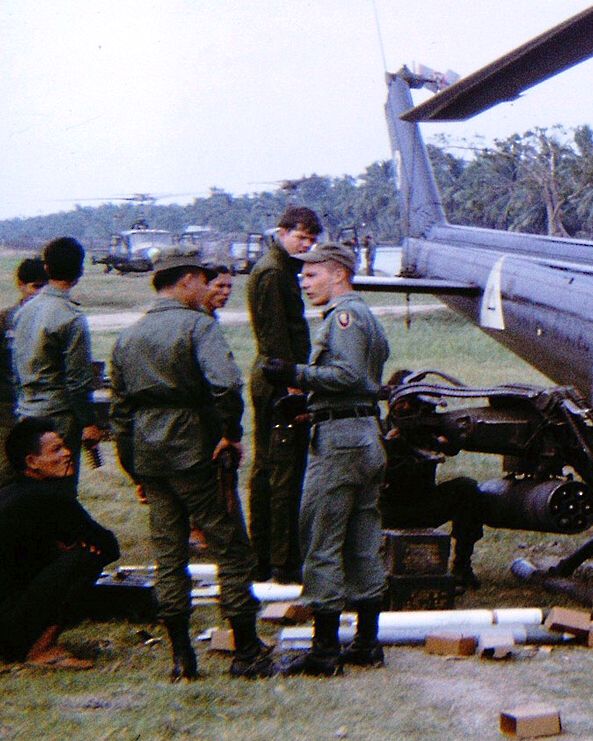
Captain Stewart confers with a Vietnamese officer during the conduct of a mission to support ground operations.
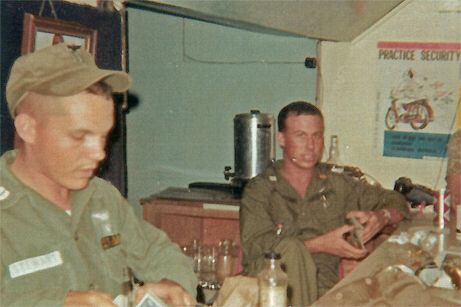
After the days missions are complete, CPT Stewart shuffles a deck of cards as CPT Mulheren watches.
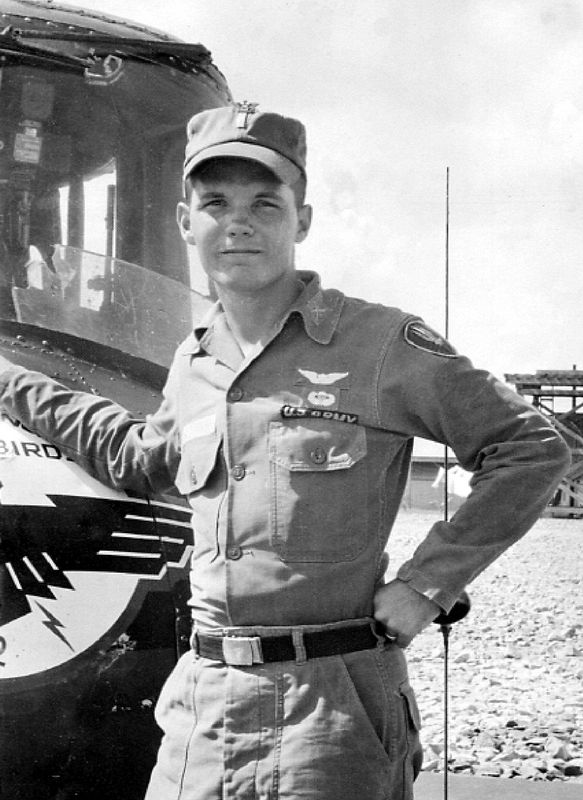
1LT Stewart poses in front of his helicopter gun ship. Note the bullet hole in the nose of the aircraft and the previous battle damage to the âtipping plateâ in the windshield.
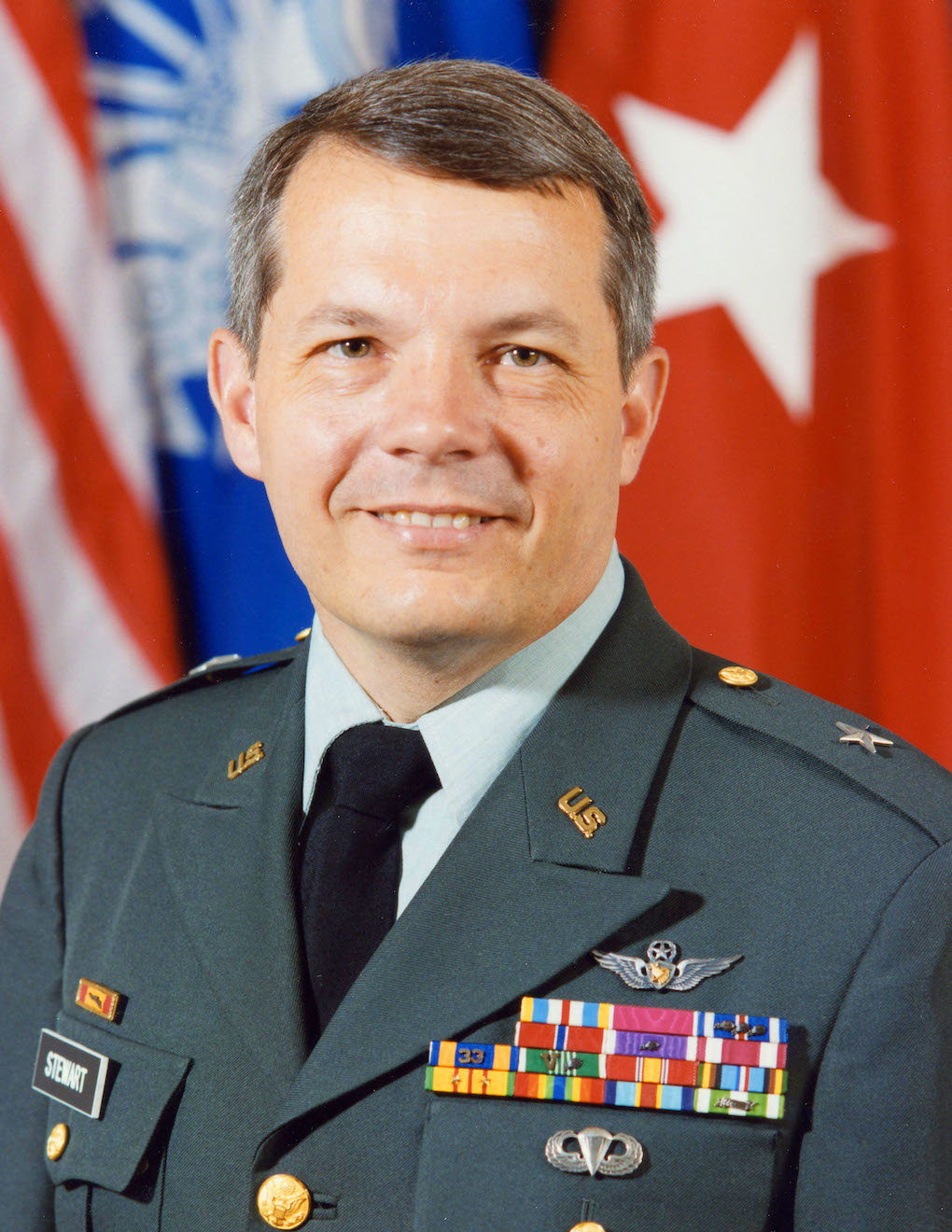
BG Bowling official Air Force photo